Ceremonies meant to honor high achievement are supposed to be about the heroes on stage. That rule tends to bend when a politician grabs the microphone.
Donald Trump recently flew down to Houston for an event at NASA's Johnson Space Center. The occasion was grand. He was there to present the Congressional Space Medal of Honor to the Artemis II crew, the brave souls who recently circumnavigated the moon and became the first humans to leave Low Earth Orbit since the Nixon era. Don't miss our recent article on this related article.
Instead of a smooth tribute, the room watched the timeline slip. The president showed up nearly half an hour late. Once he took the stage, the event quickly mutated into a stump speech about an entirely new construction project. He spent significant time teasing a brand new national institution called a U.S. Space Academy.
It was a strange scene. The astronauts stood waiting on stage while the executive branch talked real estate and future brick-and-mortar campuses. If you want more about the context of this, TIME provides an in-depth breakdown.
The Reality Behind the Space Academy Announcement
If you listened to the speech, you might have thought construction crews were already breaking ground on a massive new college campus. Trump told the crowd at Mission Control that he had just opened an academy and claimed every state was fighting to host the site.
The paperwork tells a different story.
The executive order signed that day didn't actually create a new university or military branch school. It merely set up a presidential commission. The job of this committee is to study whether a NASA-led federal academy makes sense. It is a far cry from an immediate ribbon-cutting ceremony.
Right now, officers entering the U.S. Space Force get their undergraduate education through the Air Force Academy out in Colorado Springs. Whether this newly proposed academy turns into a standalone military institution or a hybrid civilian-military school remains completely up in the air.
An Awkward Geopolitical Moment on Stage
The delays and construction talk weren't the only notable elements of the Houston visit. The medal presentation itself carried a unique diplomatic twist.
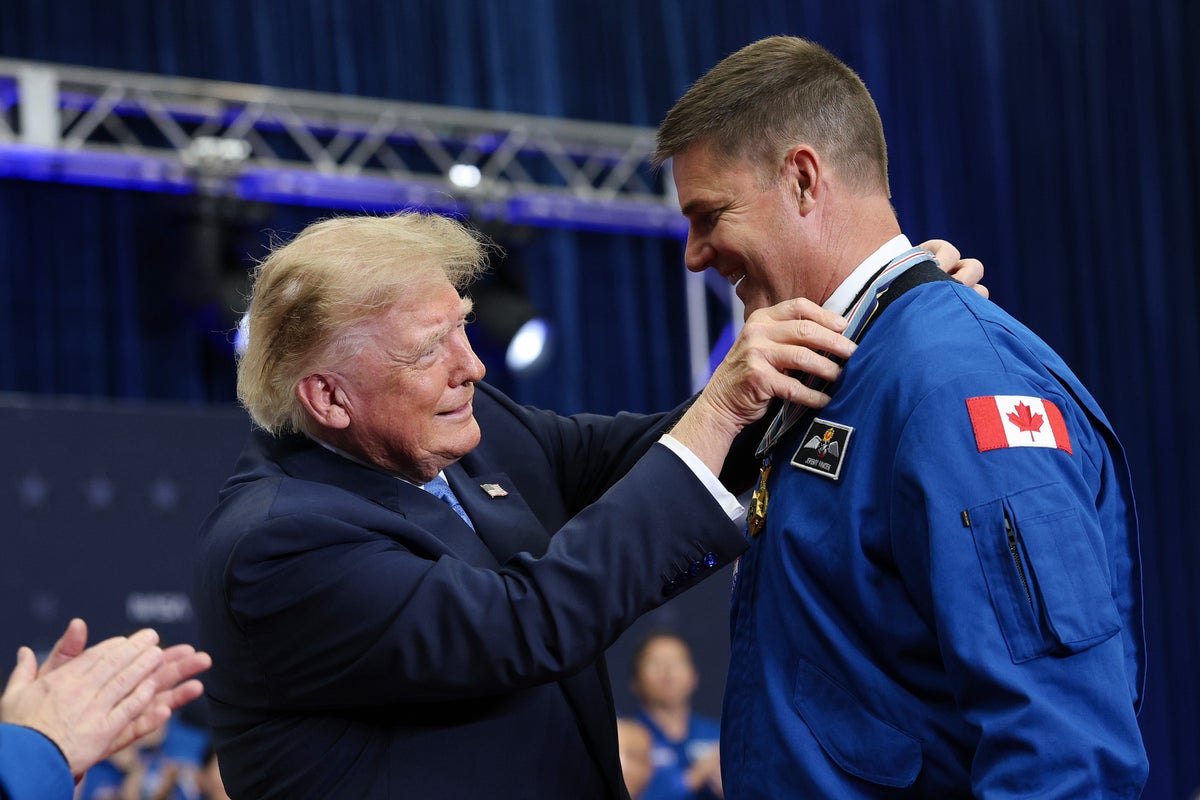
The first astronaut to receive the Congressional Space Medal of Honor was Jeremy Hansen. Hansen is a Canadian Space Agency astronaut who made history by becoming the first non-American to travel to the moon on the Artemis II mission.
Placing that medal around Hansen’s neck happened against a backdrop of tense trade discussions and a raging tariff war between Washington and Ottawa. Hansen stood at rigid attention with the Canadian flag visible on his sleeve while the president honored him. It made for a striking visual that bypassed standard political friction.
How the Message Shifted Across Houston
Politicians love a good ribbon-cutting narrative, even when the ribbon doesn't exist yet. Throughout his Houston itinerary, the upcoming academy proposal kept creeping into conversation.
- He brought it up during the primary award ceremony at Johnson Space Center.
- He mentioned it a second and third time while touring Mission Control.
- He even beamed up a message to the American crew members currently living and working aboard the International Space Station to talk about the school.
For the Artemis II crew—Reid Wiseman, Victor Glover, Christina Koch, and Jeremy Hansen—the day was supposed to be about their monumental lunar flyby. They earned every bit of that recognition by braving deep space. Yet, they found themselves serving as the opening act for a real estate pitch.
When you mix space exploration, presidential politics, and impromptu infrastructure announcements, timelines blur. The astronauts got their medals in the end. The school, however, remains trapped in a committee room.
Check the commission updates later this year if you want to know where the campus lands. For now, keep your eyes on actual rocket launches instead of political blueprints.