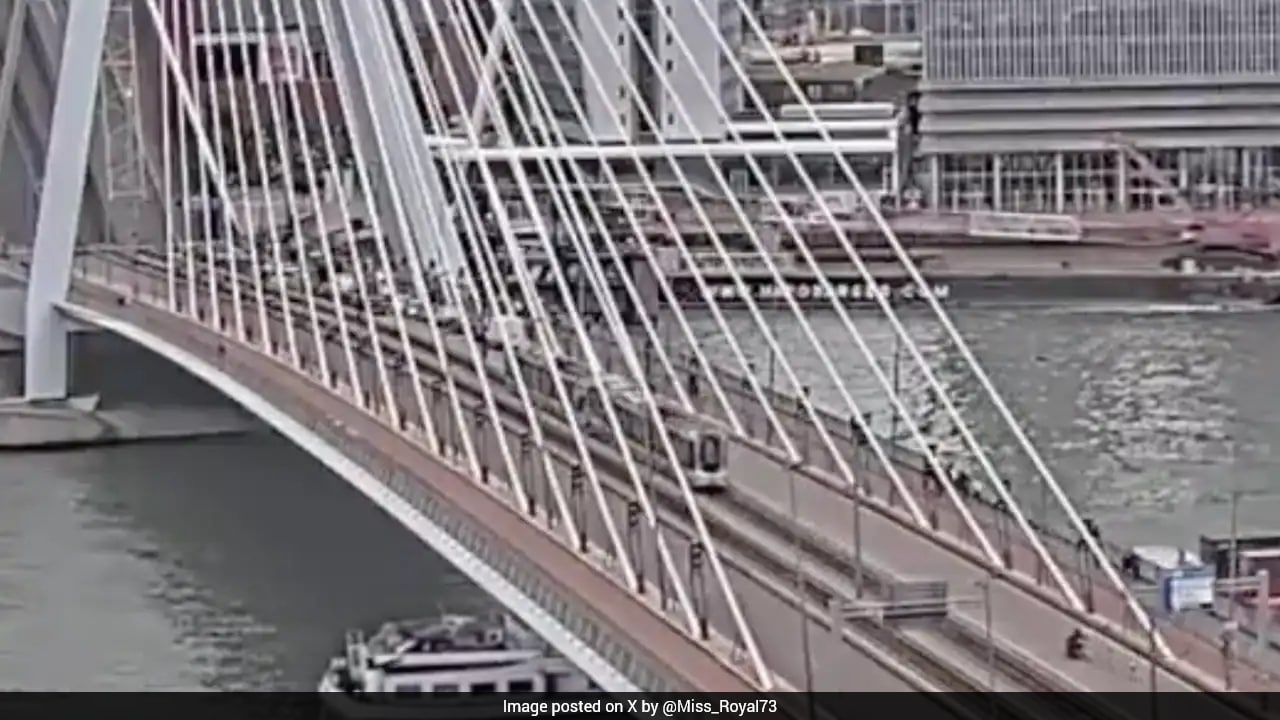
A high-speed rear-end collision between two public transit trams shut down Rotterdam's iconic Erasmus Bridge on July 22, 2026, leaving 15 people injured and casting a spotlight on urban transit safety systems.
The crash happened around 11:10 a.m. local time when a stationary tram waiting in front of the opened drawbridge was slammed into from behind by another incoming tram traveling at significant speed. The severe force of the impact derailed one of the vehicles, scattered heavy metal debris and glass onto the roadway, and damaged two parked cars nearby.
Emergency crews rushed to the landmark cable-stayed bridge spanning the Nieuwe Maas river. Responders dispatched a trauma helicopter alongside police, fire, and medical teams to extract trapped passengers. Initial reports from the regional safety board (Veiligheidsregio Rotterdam-Rijnmond) estimated 18 casualties, but authorities later revised the figure down to 15 injured, with five requiring hospitalization and one person sustaining critical, life-threatening injuries.
The driver of the rear tram was among those taken to the hospital, though preliminary breathalyzer tests confirmed he was sober at the time of the crash.
Rotterdam Erasmus Bridge Incident Breakdown
--------------------------------------------------
Time of Impact:      ~11:10 AM local time
Location:            Erasmus Bridge (Erasmusbrug), Rotterdam
Vehicles Involved:   Two RET Trams + Two Damaged Cars
Casualty Count:      15 Total Injured (1 Critical, 5 Hospitalized)
Bridge Status:       Closed in both directions
Substance Testing:   Driver tested negative for alcohol
How the Erasmus Bridge Tram Collision Unfolded
Witnesses and local webcam footage capture a clear sequence of events. The lead tram came to a halt on the approach to the Erasmus Bridge, stopping as required while the bascule portion of the bridge was raised to let maritime traffic pass along the river below.
Seconds later, a second tram coming from the direction of Rotterdam's city center entered the bridge approach. According to eyewitness accounts and local traffic video, the trailing tram approached rapidly and struck the rear of the stopped vehicle without apparent deceleration.
The force of the impact threw passengers out of their seats and onto the floor. One passenger became pinned in the mangled metal framework inside the carriage and required specialized extraction tools from the fire service before being rushed to an emergency trauma unit.
Public transit operator RET (Rotterdamsche Electrische Tram) immediately cut power to the overhead catenary lines across the bridge to prevent electrical fires or secondary electrocution risks during rescue operations. Police closed the Erasmus Bridge entirely to vehicular traffic, cyclists, and pedestrians, causing major delays across the city's transit network. Tram lines 3 and 5 were short-turned or rerouted away from the waterfront area.
Why Automatic Braking Systems Are Facing Scrutiny
This isn't an isolated incident for Rotterdam's transit network. Just over a year prior, on July 11, 2025, two RET trams collided at the busy Kruisplein intersection in central Rotterdam, injuring eight people and leading to the arrest of a tram operator.
The repeat nature of these head-to-tail impacts raises direct questions about the safety mechanisms installed on modern light rail vehicles.
Modern trams operate with multiple redundant safety features designed to prevent precisely this type of collision:
- Dead Man's Control (DMC): A continuous pressure switch or pedal that the driver must hold down while operating the vehicle. If the driver loses consciousness or lets go, emergency brakes engage automatically.
- Automatic Train Protection (ATP) & Distance Sensors: Onboard radar or trackside sensors designed to calculate stopping distances based on speed and proximity to stationary objects or red signals.
- Track Brakes (Electromagnetic Brakes): High-powered emergency magnets that pull directly against the steel rails to stop vehicles faster than conventional hydraulic disk brakes.
Given that the rear tram driver was sober, investigators are examining three potential failure points: mechanical brake failure, sudden driver incapacitation where pressure on the dead man's switch wasn't fully released, or signal/sensor malfunction near the bridge control area. RET officials expressed shock over the footage and confirmed a full technical investigation is underway.
Real World Transit Safety Lessons and Next Steps
When light rail accidents occur on major bridges, the impact reaches far beyond immediate passenger injuries. Bridge spans concentrate traffic, limit emergency access lanes, and complicate passenger evacuation.
If you regularly commute via urban light rail or find yourself in a public transit emergency, keep these practical safety steps in mind:
- Know emergency release positions: Modern trams feature manual door release levers near entryways. Familiarize yourself with their locations on your daily commute route.
- Brace effectively upon impact: If you hear emergency braking or horn warnings, tuck your chin, brace your feet firmly on the floor, and grab fixed handrails rather than floating straps.
- Check for live wires before exiting: In derailment scenarios involving overhead catenary systems, do not rush out of damaged tram doors until emergency crews verify that overhead power lines are disabled. Broken high-voltage cables touching the tram's exterior present severe electrocution risks.
- Monitor local transit advisories: For residents in Rotterdam, avoid the Erasmusbrug area while structural inspectors evaluate the roadway and rail tracks. Use the Willemsbrug or Erasmus metro tunnels (Lines D and E) as alternative routes across the Nieuwe Maas.