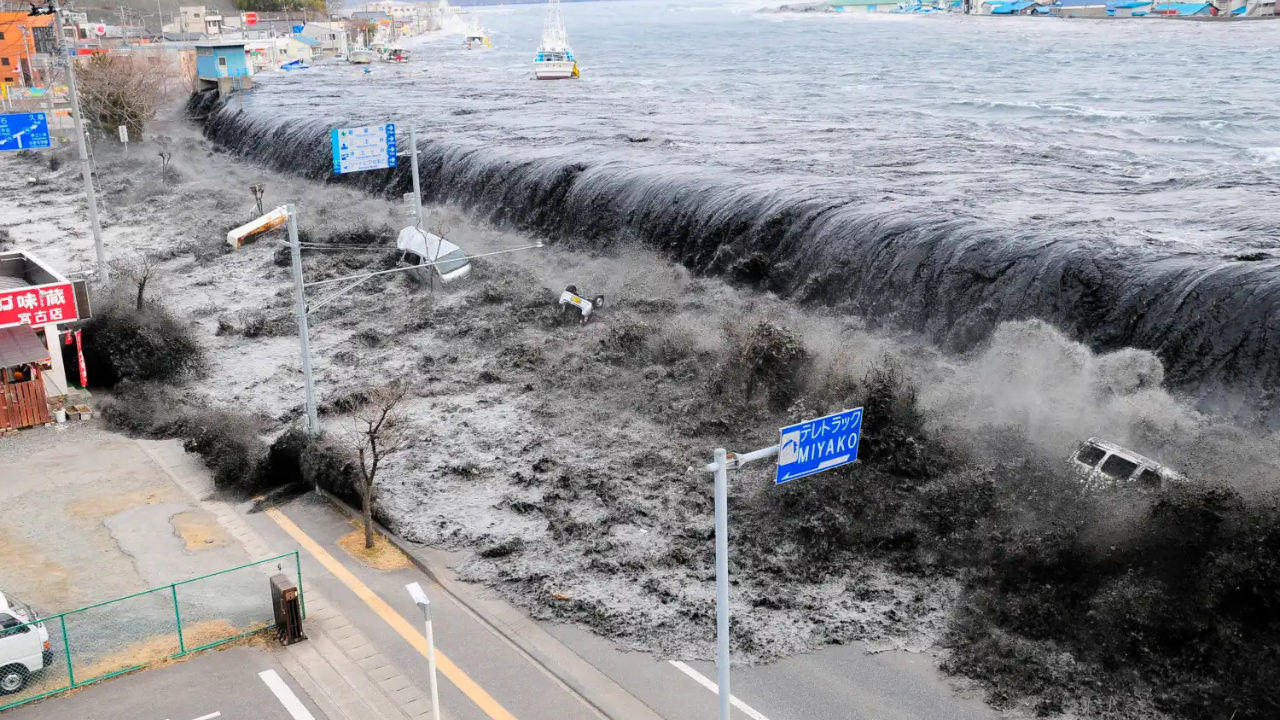
On March 11, 2011, a massive tectonic rupture off the coast of Tohoku, Japan, changed the world in a matter of minutes. The magnitude 9.0 disaster was so violent that it altered Earth’s axis, sped up the planet’s rotation, and triggered a tsunami that devastated coastal communities. We thought we had mapped every major physical consequence of that terrible day. We were wrong.
While we thought we understood the sheer scale of Japan's 2011 megaquake, a stunning scientific discovery has revealed a hidden chapter of the disaster. It turns out the earthquake sent a massive seismic wave plunging straight down to the edge of Earth's liquid core, which then bounced back to the surface and physically shoved the entire nation of Japan eastward.
This isn't science fiction. It's the sober conclusion of a groundbreaking study published in the journal Science. Led by geophysicist Sunyoung Park of the University of Chicago, alongside legendary Caltech seismologist Hiroo Kanamori and Luis Rivera of the University of Strasbourg, the research exposes a phenomenon never before seen in human history. For the first time, scientists have proof that a wave bouncing off Earth's core can actually trigger tectonic plates to slide near the surface.
The ghost in the GPS data
To understand how we missed this for over a decade, you have to look at Japan’s state-of-the-art monitoring systems. Japan is wrapped in a dense blanket of GPS and satellite receivers known as GEONET. It tracks the ground's movement in real time, down to the millimeter.
When the main shock hit in 2011, GEONET went wild. But about 15 minutes after the initial violent shaking subsided—long before the major aftershocks began—something truly bizarre showed up in the data. Every single GPS station across the entire length of the Japanese archipelago registered a tiny, uniform step to the east.
It was tiny. Only five to six millimeters.
Nobody felt it. It didn't cause any damage. But it happened everywhere at the exact same moment, from Hokkaido in the frozen north to Kyushu in the warm south.
For years, seismologists didn't know what to do with this signal. In a chaotic post-quake environment filled with sensor noise, massive aftershocks, and a humanitarian crisis, this five-millimeter blip was treated like an anomaly. Some researchers assumed it was a data processing glitch. Others thought it was a localized error.
Park and her team decided to clean up the archive and look closer. When they filtered out the overwhelming seismic noise of the mainshock, they realized the shift wasn't a glitch. It was real, it was permanent, and it happened with absolute synchronization across 1,800 miles of territory.
The deep dive of the seismic wave from Japan's 2011 megaquake
How does a whole country take a synchronized, silent step to the side? The answer lies nearly 2,900 kilometers beneath our feet.
When a megaquake strikes, it doesn't just send waves rippling across Earth's surface. It radiates energy downward, deep into the planet's interior. Among these deep-traveling signals are ScS waves.
These are shear waves, or S-waves, which can only travel through solid rock. They barreled through Earth’s solid mantle at extreme speeds, diving deeper and deeper until they reached the core-mantle boundary. This boundary represents one of the most violent transitions in our solar system, where solid rock meets a churning, superheated ocean of liquid iron and nickel.
Because S-waves cannot travel through liquids, they hit this boundary and bounced.
Think of it like a billiard ball striking a solid cushion. The liquid core acted as a giant geological mirror, reflecting the seismic energy right back up toward the surface.
The round-trip is staggering.
- One-way trip down: 2,900 kilometers
- Total distance: 5,800 kilometers (nearly the radius of the Earth)
- Travel time: Exactly 13 to 15 minutes
When the returning wave finally reached the surface, it arrived across Japan essentially at the same moment.
Why this echo was different
Seismologists have known about ScS waves for a very long time. In fact, they use them to map the interior of the Earth. But under normal circumstances, these waves are incredibly weak by the time they get back. Earth's mantle acts like a giant sponge, absorbing seismic energy and scattering it. Usually, ScS waves return as a faint whisper, barely detectable by highly sensitive instruments.
But the 2011 Tohoku quake was an absolute monster.
The energy it released was so immense that the returning ScS wave still had an astonishing peak-to-peak amplitude of over a centimeter when it hit Japan's surface. It was the strongest reflected wave ever recorded. It wasn't a whisper anymore. It was a physical punch.
How the echo unzipped a tectonic boundary
When this massive wave slammed into the underside of the Japanese islands, it found tectonic plates that were already in a state of utter ruin.
The main shock of the earthquake had violently shaken the region for six minutes, leaving the boundaries between the plates highly unstable and frictionless. The faults were under extreme, unresolved stress, essentially balanced on a knife-edge.
When the returning wave arrived, it acted as a trigger.
[Main Earth Rupture]
       │
       ▼ (S-wave travels down 2,900 km)
[Core-Mantle Boundary] (Reflection)
       │
       ▲ (ScS-wave travels up 2,900 km)
[Weakened Fault Lines] (Triggered Slip) ──► Japan shifts 6mm East
The wave pushed the tectonic plates just enough to cause a massive, synchronized slip. This slip didn't happen in just one spot; it occurred across an area stretching over 3,000 kilometers. It activated two entirely separate plate boundaries at once:
- The intersection of the Pacific and Okhotsk plates.
- The intersection of the Philippine Sea and Eurasian plates.
Nothing like this had ever been documented. It was a massive, quiet slide that permanently relocated the entire nation.
The massive invisible earthquake
The sheer scale of this triggered slip is mind-blowing. Park’s team calculated that the energy released by this synchronized movement was equivalent to a magnitude 7.5 earthquake.
If a standard magnitude 7.5 earthquake strikes near a populated area, it causes catastrophic damage, collapses buildings, and tears up roads. Yet, nobody in Japan felt a thing from this one.
Why? It comes down to speed and area.
Instead of rupturing violently along a single fault line over a few seconds, this triggered slip was incredibly slow. The plates slid quietly over the course of about three minutes, distributing that massive energy over a sprawling 3,000-kilometer stretch of fault lines. Because the motion was so slow and spread out, it didn't generate the high-frequency seismic waves that make ground shake and buildings fall. It was, for all practical purposes, an invisible, silent megaquake.
Ruling out the simple answers
Scientists don't make claims like this without exhausting every other possibility first. Before publishing their findings in Science, Park and her colleagues spent years stress-testing alternative explanations.
Could it have been an unrecognized aftershock?
An aftershock strong enough to move the entire country would have left a massive, unmistakable signature on seismometers. There was no such signal.
What about a giant submarine landslide?
A massive underwater collapse, triggered by the initial shaking, could theoretically shift local ground sensors. But a landslide cannot explain why stations thousands of miles away in Hokkaido and Kyushu shifted at the exact same millimeter scale and at the exact same second.
Did the main shock just keep releasing energy?
If the main rupture had simply dragged on longer than we thought, the resulting movement would have been highly concentrated near the epicenter off the coast of Tohoku. The displacement would have quickly faded as you traveled further away. Instead, the five-to-six millimeter shift was uniform across the entire length of Japan.
Only the core-reflected wave model, which hits the entire tectonic boundary from underneath like a wide-angle flashlight, perfectly fits the data.
The dangerous new reality of seismic hazards
This discovery is incredibly cool, but it also introduces a terrifying new variable to global seismic hazard modeling.
For a long time, we assumed that aftershocks and secondary ruptures were localized threats. We believed that if a massive earthquake hit, the primary danger of triggering new faults was limited to the surrounding region.
Now, we know that isn't true.
A megaquake can launch a massive, slow-moving weapon straight down into the Earth. That wave will bounce off the core, travel back up, and can theoretically reactivate faults thousands of miles away, long after the primary shaking has stopped. This deep-earth echo essentially bypasses the surface crust, traveling through the deep mantle to deliver a targeted hit to fragile tectonic boundaries from below.
As Park pointed out, this represents a previously unrecognized source of seismic hazard. If a core-reflected wave can trigger a slow, harmless slip of five millimeters, what happens if the returning wave hits a fault that is primed for a violent, catastrophic rupture? It could theoretically trigger a second major, destructive earthquake on the other side of a continent, fifteen minutes after the first.
Retraining our sensors for the next big one
Our current seismic warning systems and earthquake hazard maps don't take core-reflected waves into account. They are entirely designed to look for high-frequency, immediate surface shaking.
The next step for global seismology is clear:
- Re-evaluate historic data: Seismologists need to go back through the archives of other historic megaquakes—like the 1960 Valdivia earthquake in Chile or the 2004 Indian Ocean earthquake—to see if similar hidden slips occurred.
- Upgrade GNSS processing: Real-time satellite positioning data needs to be processed with algorithms that actively search for these delayed, country-wide step-overs in the minutes following a major event.
- Map vulnerable deep-wave paths: We must identify which global fault systems are most vulnerable to being triggered by deep-core reflections.
The earth under our feet isn't a static block of rock. It is a highly complex, connected system where a slip on the surface can ring the planet like a bell, bouncing off its liquid metallic heart and reshaping geography when it returns.
For a deeper visual dive into how these seismic waves travel through the Earth's interior and interact with the core-mantle boundary, check out this Deep Reflections Video. This animation clearly demonstrates how deep-earth vibrations can travel thousands of kilometers to reactivate faults at the surface.