If you think hydrogen fuel cells are dead in the water compared to standard lithium batteries, you haven't been paying attention to what is happening in materials science labs. Proton-exchange membrane fuel cells have long suffered from an annoying physical bottleneck. Protons move too slowly through dense catalytic layers. That sluggishness limits power output, forcing engineers to build bulky, heavy stacks just to get decent performance out of a vehicle or a power plant.
Researchers at the Beijing Institute of Technology just blew past that obstacle. Published in the journal Science, their work details a redesigned catalyst interface that quadruples the power output of standard hydrogen fuel cells. It isn't just an incremental tweak. It is a structural rethink that fixes the core reason hydrogen engines have struggled to compete with battery-electric setups on sheer power density.
The Relay Race Inside the Fuel Cell
To understand why this new design matters, you have to look at what actually happens inside a fuel cell. At the anode, hydrogen molecules split into protons and electrons. While electrons travel through an external circuit to do useful work, protons must migrate across a polymer electrolyte membrane to reach the cathode.
In traditional cell architectures, protons have to plow directly through tortuous, dense ionomer films. It is slow, inefficient, and creates massive resistance.
The Beijing team solved this by engineering a Brønsted acid-Lewis base interface that acts like a microscopic relay race. Instead of forcing protons to crawl blindly through a thick barrier, the architecture creates intermediate energetic islands. Protons hop rapidly from one basic coordinating site to another across a pre-aligned hydrogen-bonding network.
Laboratory tests show staggering metrics. The new material increases proton diffusion tenfold, improves proton conductivity by 6.5 times, and cuts activation energy in half. Under standard operating conditions, the cell generates four times the power of conventional designs, hitting 0.75 watts per square centimeter at 0.7 volts.
Sashing Platinum Use Without Sacrificing Power
Let's talk about money. Platinum is the dirty word in hydrogen fuel cell manufacturing. It is scarce, fiercely expensive, and accounts for a massive chunk of a stack's production cost. Historically, if you wanted more power, you threw more platinum at the problem.
The new interface design completely flips that equation. Because the relay mechanism accelerates proton transport so efficiently, it unlocks the full catalytic potential of minimal platinum loadings.
The system achieves an incredible 6.9 kilowatts of power per gram of platinum. For context, that leaves current state-of-the-art tech in the dust. A commercial 100-kilowatt automotive stack could run on less than 15 grams of platinum, bringing manufacturing costs down to a level where heavy-duty commercial production actually makes economic sense.
Durability is another huge win here. Traditional cells degrade fast under stress. After 30,000 cycles of accelerated stress testing—a brutal charge-and-discharge cycle designed to age components rapidly—this new design retained 63 percent of its peak power. Conventional systems under identical conditions dropped to just 30 percent.
Beyond the Highway
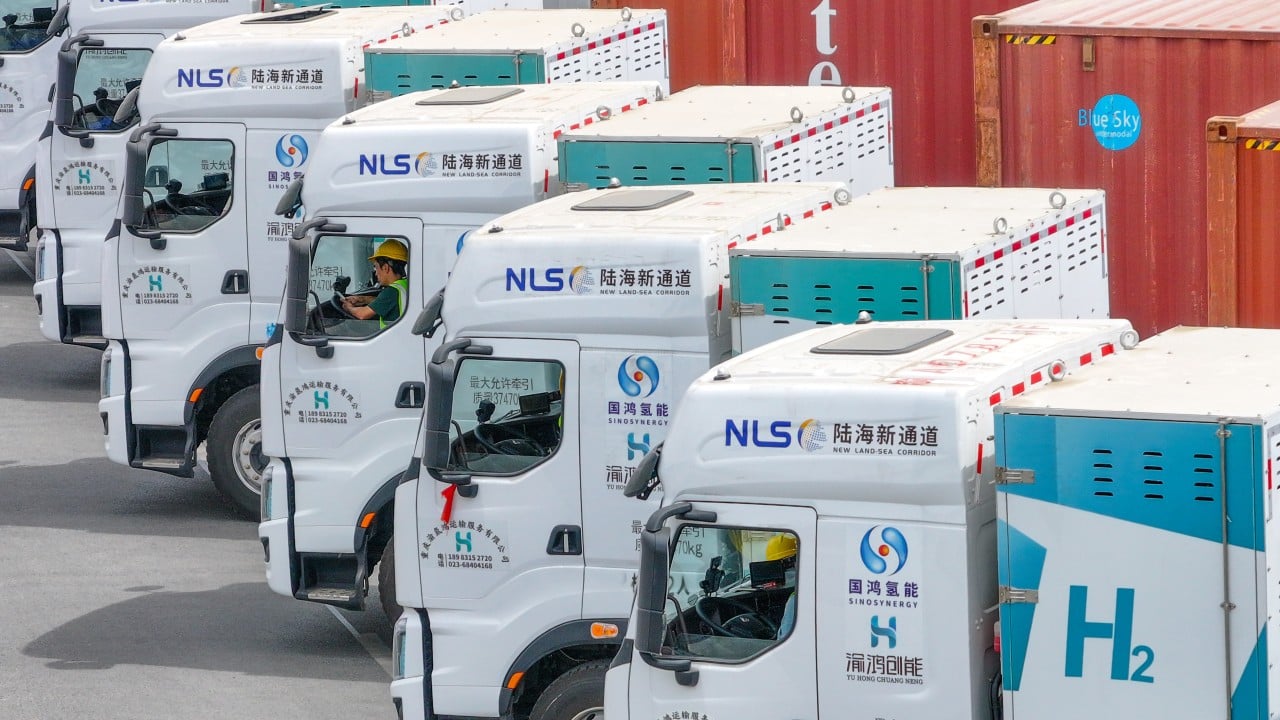
While passenger cars get most of the media hype, heavy transport is where hydrogen actually shines. Long-haul trucks, cargo ships, and industrial fleets need rapid refueling and continuous high-wattage output that chemical batteries struggle to provide without adding dead-weight payloads.
Assistant Professor Li Jie, one of the study's co-authors, points out that a fourfold increase in power density shrinks the overall size and weight of the fuel cell stack. Trucks can maintain stronger continuous output, preserve their cargo capacity, and enjoy a much longer driving range.
There is also an unexpected frontier: aerospace. Terrestrial vehicles draw ambient air containing about 21 percent oxygen, but spacecraft and planetary landers rely on closed systems fed with pure liquid oxygen. Under pure oxygen conditions, high proton throughput is the primary metric that governs power output. This design fits the exact specifications required for next-generation aerospace energy systems.
What Happens Next
Scaling up laboratory breakthroughs is usually where brilliant science goes to die. But the research team is already addressing manufacturing realities. Right now, the lab can produce about 100 grams of the composite material in three days—enough to build roughly ten 100-kilowatt stacks.
China's broader ecosystem is priming itself for this transition. With more than 130 fuel-cell power plants already operating domestically by the end of 2025 and national policies officially backing hydrogen as a core growth sector, the infrastructure is slowly catching up to the chemistry.
The immediate next step for the research group is building and testing full-scale high-performance stacks across different real-world operating scenarios. If those field tests match the lab metrics, the commercial viability of hydrogen transport just crossed a major threshold. Stop betting against fuel cells; the materials science is finally catching up to the ambition.