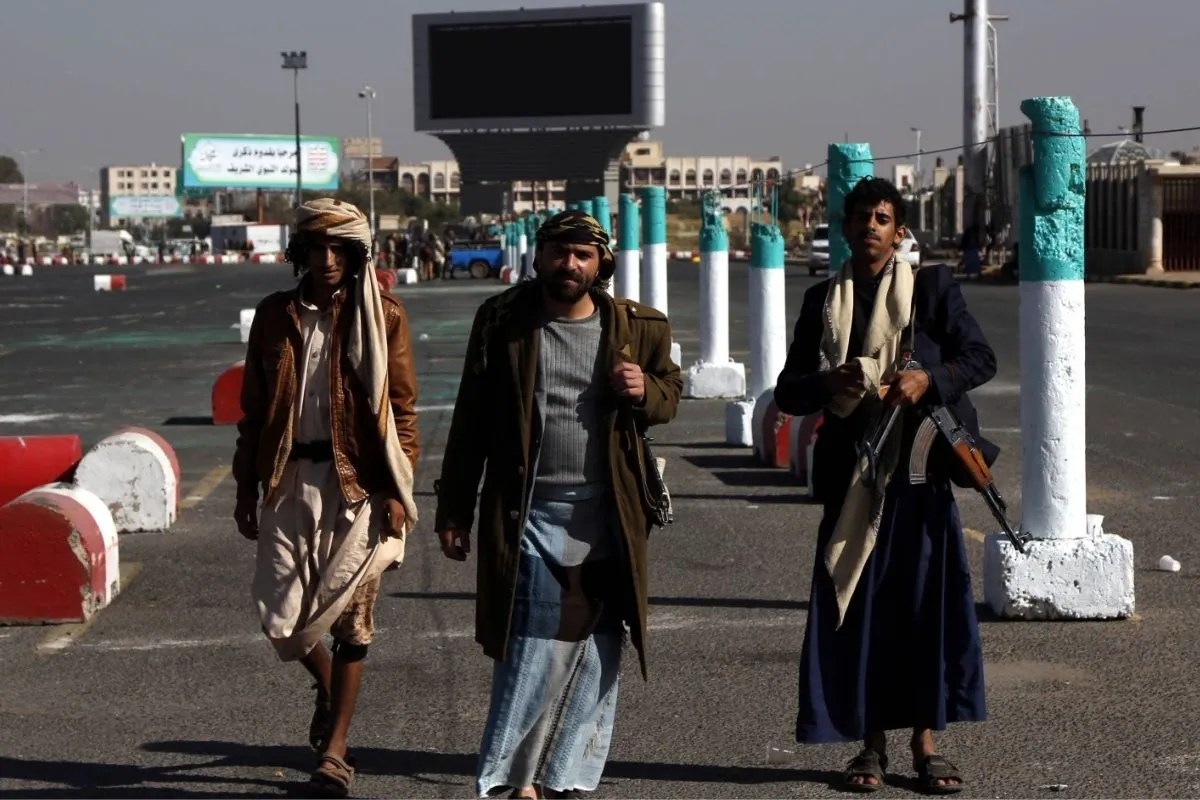
People always ask how a rebel group operating inside one of the world's poorest nations manages to fire advanced missiles and disrupt global shipping lanes without breaking a sweat. The answer isn't just external charity. It’s an institutionalized war economy built on heavy taxes, domestic monopolies, and strategic control over regional choke points. When you look past the headlines about drone attacks and maritime blockades, you find a sophisticated parallel financial system keeping the Houthi movement flush with billions.
The Anatomy of the Houthi Parallel Economy
You can't fund a multi-year military campaign on sheer ideological willpower alone. Since taking over Sana'a, the group has systematically restructured commercial activity across northern Yemen to extract maximum revenue. Reports from regional research groups like the Mokha Centre show that traditional merchant families have seen their influence shrink, replaced overnight by a network of loyal corporate entities.
These aren't random operations. They're calculated commercial structures managing everything from fuel distribution to currency exchange. If you want to import food, medicine, or energy into territories under Houthi control, you play by their rules. Compliance means paying steep fees that funnel straight back into military and security budgets.
Customs, Levies, and Domestic Extraction
Taxation is where the real money comes in. Independent analysts note that customs checkpoints established by the group squeeze commercial transport hard. Importers routinely report paying exponentially higher tariffs at Houthi-controlled entry points compared to those run by the internationally recognized government.
This heavy-handed extraction hits ordinary citizens hardest in a country where the vast majority of food is imported. Yet, for the administration in Sana'a, these checkpoints generate staggering yields, pulling in billions in local currency equivalents annually. On top of standard customs, religious donations through institutionalized bodies like the Zakat Authority add hundreds of millions more to the war chest.
Energy, Shipping, and International Networks
Energy is the crown jewel of this financial architecture. By tightening their grip on petroleum imports, transport networks, and storage facilities, the group turned fuel distribution into a primary source of liquid capital.
At the same time, international monitors point to cross-border financial networks extending through regional allies that help bypass global sanctions. By utilizing specialized currency-exchange channels and oil-smuggling circuits linked to the Iranian Revolutionary Guard Corps, substantial funds flow directly into procurement channels for dual-use technologies.
When maritime tensions spike and crude oil prices surge past one hundred dollars a barrel, the economic shockwaves benefit actors positioned to manipulate or exploit the chaos. Strategic geographical positioning along the Bab al-Mandeb strait gives them unmatched leverage over global supply chains, ensuring their financial engine keeps running regardless of external pressure.
Look at the mechanics of modern insurgencies. They survive by replacing state institutions with self-sustaining revenue models. Until those domestic financial lifelines and smuggling conduits face systematic disruption, the funding streams powering these conflicts will remain entirely intact.