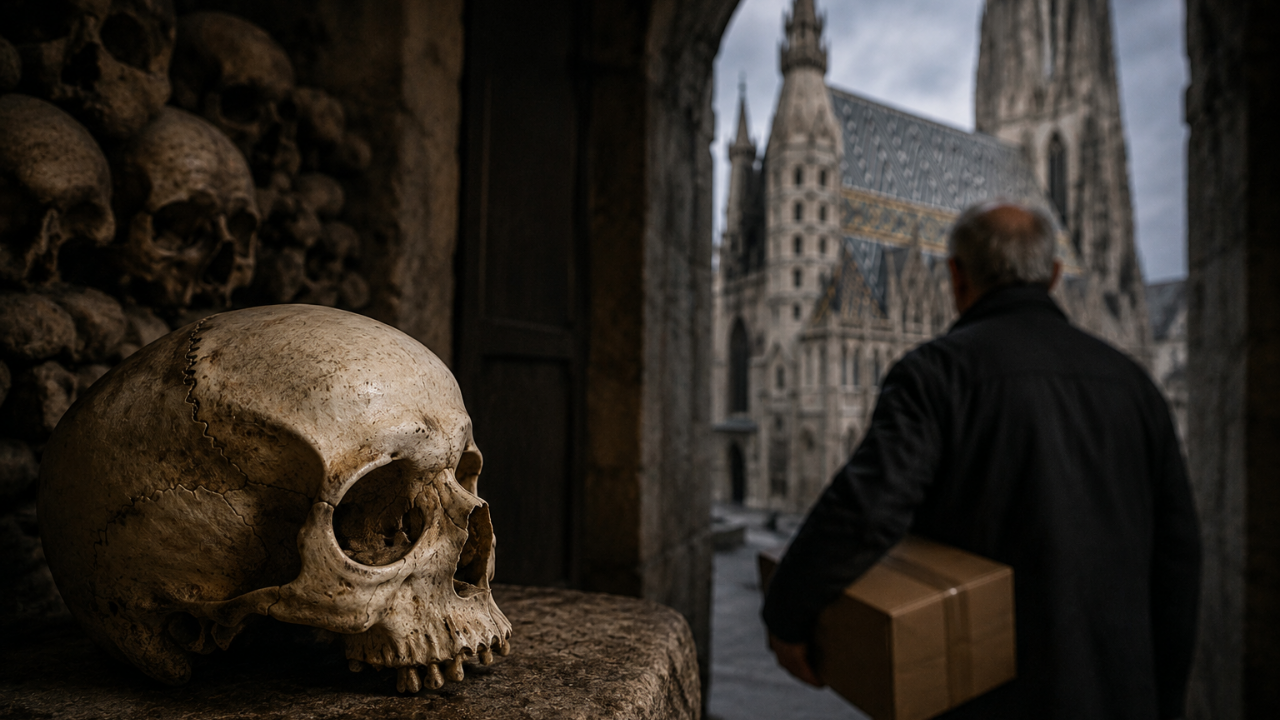
Imagine sitting at your desk on a standard workday, opening a heavily taped cardboard package, and pulling out a human skull.
That is precisely what happened to Franz Zehetner, an official and architect associated with Vienna's historic St. Stephen's Cathedral. There was no return address. Just a massive parcel, a set of human remains, and a confession letter written by an elderly man living in northern Germany.
Six decades earlier, the sender had visited the cathedral's underground catacombs as a reckless young tourist. He slipped a skeletonized head into his bag and walked out. Sixty years later, facing the twilight of his life, his conscience caught up with him. He wanted the skull back where it belonged before he ran out of time.
This bizarre story exposes the strange weight of long-held guilt and the unique security realities surrounding historic subterranean tourist sites.
What Lies Beneath St Stephen's Cathedral
To understand the audacity of the theft, you have to look at the scale of the catacombs beneath Vienna's famous landmark, locally known as "Steffl".
St. Stephen's Cathedral isn't just an architectural masterpiece on the surface. Beneath the floors lies a massive labyrinth of burial vaults and catacombs. Centuries ago, thousands of Viennese citizens—roughly 11,000 people, primarily from the 18th century—were laid to rest in these underground chambers.
When historic cemeteries like the old Stephansplatz graveyard were cleared out to make room for a growing city, the bones were relocated to the crypts. Skulls and skeletal remains were stacked by the thousands in secondary burials.
Decades ago, security and crowd control during guided tours were far more relaxed than they are today. Monitored pathways weren't lined with modern surveillance cameras or glass barriers. A curious visitor with a dark impulse could easily reach out, pocket a piece of history, and walk straight out into the Austrian sunshine unnoticed.
The Anatomy of a Sixty-Year Guilty Conscience
Most people who commit petty thefts or impulsive souvenir grabs as teenagers or young adults manage to rationalize them over time. They forget, or they laugh it off.
Not this guy.
According to the letter received by cathedral officials, the German tourist held onto the human skull for roughly 60 years. Think about that span of time. He moved through adulthood, built a career, likely watched his children grow up, and grew old—all while harboring a stolen human head in his possession.
Psychologists often talk about how moral weight shifts as people age. When you are young, mortality feels abstract. Consequences feel distant. You think you can get away with anything.
Near the end of life, the psychological landscape changes entirely. Unresolved transgressions start to loom large. The anonymous sender explicitly noted that he wanted to come to terms with himself and find inner peace before his time ran out. Mailing a stolen skull back to the church was his final attempt at restitution.
How Cathedral Officials Handled the Macabre Delivery
Receiving human remains through standard postal logistics is a logistical and legal nightmare for most institutions. Yet, cathedral architect Franz Zehetner reacted with a surprising degree of grace and empathy.
Instead of treating the package purely as a criminal piece of evidence to hand over to local law enforcement, church authorities focused on the human element. Zehetner noted that he was deeply moved by the gesture. Despite the unorthodox and illegal method the sender used to acquire and keep the skull, the man had preserved the remains carefully over six decades instead of tossing them into a dumpster.
Can the skull be traced back to its specific human identity?
No. Experts quickly realized that matching the returned skull to individual records is entirely impossible. Because the catacombs consist of mass secondary burials from centuries-old city clearances, the bones had already lost their individual markers long before the tourist pocketed one.
Instead of a forensic mystery, the return became an anonymous closure. Cathedral workers ensured the skull received a dignified final resting place back within the subterranean vaults, quietly rejoining the thousands of nameless historical residents down below.
Why Tourism Ethics Still Require Strict Boundaries
This incident serves as a bizarre reminder of how souvenir culture can cross deeply unethical lines.
For generations, travelers have treated historical and sacred sites as open-air gift shops. People chip pieces off the Colosseum, pocket sand from protected beaches, and—in extreme cases like this one—walk away with human remains.
Heritage sites have responded aggressively over the last few decades. Heavy fines, bag checks, surveillance systems, and strict guided tour protocols now protect places like the Vienna catacombs. Tourists are routinely reminded that historic ruins are not treasure troves for personal collections.
The anonymous German tourist got away with his crime for sixty years, avoiding legal penalties entirely because the statute of limitations had long passed and church authorities chose understanding over prosecution. But he paid a heavy psychological price, carrying the secret for nearly a full human lifetime.
If you ever feel tempted to pocket a piece of history on your travels, remember the old man in northern Germany. Leave the artifacts where they belong, unless you want to spend your final decades wondering how you are going to mail them back.