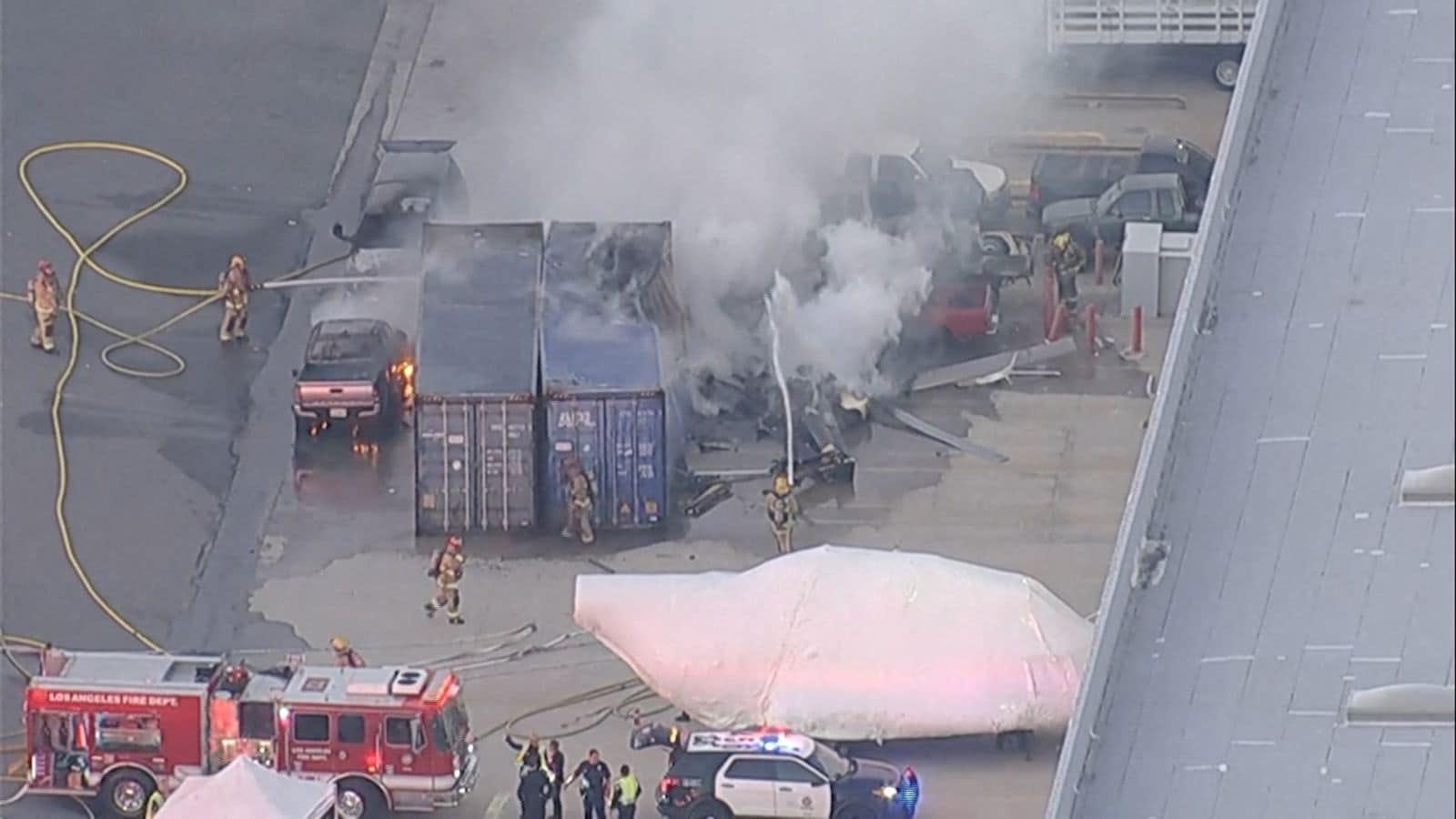
Two separate catastrophes collided in Los Angeles on a Tuesday evening, leaving five people dead and shaking the local journalism community to its core. What started as a tragic transit accident involving a runaway SUV and a city bus quickly compounded into a second disaster when an NBC4 news helicopter went down during live aerial reporting.
If you followed the breaking reports, you know the basic timeline. At around 5:00 PM, an SUV slammed directly into a Metro bus in the Chatsworth neighborhood of the San Fernando Valley. That initial crash killed multiple people and injured several others. Barely two hours later, as news crews swarmed the airspace to capture the carnage, NewsChopper 4 lost altitude and plummeted into a parking lot roughly a mile and a half away. Meanwhile, you can read similar stories here: Why The Eu Canada Associate Member Idea Is Mostly Smoke And Mirrors.
Three people died in the aircraft crash: veteran pilot George Marciniw, photojournalist and reporter Eliana Moreno, and Edy Gutierrez Mejia, a 29-year-old man on the ground.
The Last Moments in the Sky
Investigators from the National Transportation Safety Board recovered onboard video that captures the terrifying final seconds of the flight. Audio recordings reveal a mechanical warning tone beeping inside the cockpit before a crew member's voice utters a simple, chilling phrase: "uh oh". The Eurocopter AS350 then veered away from the primary bus crash zone, losing altitude rapidly before the feed cut out. To understand the bigger picture, we recommend the recent report by The Washington Post.
NTSB investigator Fabian Salazar noted that the audio logs show engine speed fluctuations right alongside advisory cockpit tones. But determining the root cause will take months of detailed wreckage analysis.
Aerial reporting is inherently high-risk. Networks rely on these aircraft to provide immediate visual context for fast-moving stories, forcing pilots and camera operators into crowded, chaotic airspace. When multiple news choppers converge on a single urban emergency, the margin for error shrinks to almost zero.
Remembering the Crew Behind the Lens
In the television industry, reporters in the sky are often disembodied voices or brief video credits. Colleagues at NBC4 and Telemundo 52 spent their broadcasts remembering Moreno and Marciniw as dedicated professionals who loved what they did. Moreno was known for handling police scanners, assignment desks, and bilingual reporting simultaneously while operating the camera. Marciniw was remembered by friends as a meticulous pilot who ran exhaustive pre-flight safety checks.
The double tragedy in Chatsworth highlights the heavy human cost paid by first responders, transit riders, and media workers who rush toward danger while everyone else runs away.
Review your local airspace safety protocols and stay updated on the official NTSB findings as the investigation unfolds.


