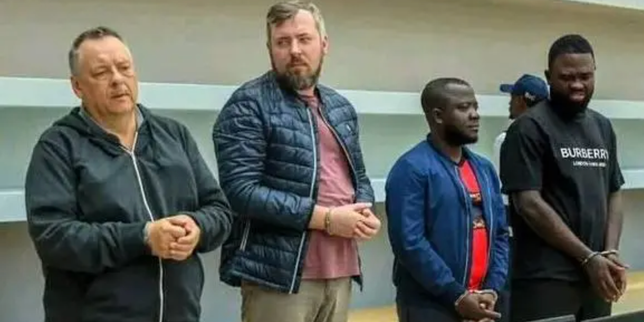
Luanda just sent a massive shockwave through the international community. A court in the Angolan capital handed down heavy prison sentences to two Russian nationals accused of terrorism and espionage. Political consultant Igor Ratchin got 11 years, while his translator, Lev Lakshtanov, received eight. The state claims they were plotting a coup, funding the political opposition, and orchestrating the bloody fuel price riots that rocked the country last year.
If you look at the surface, it looks like a textbook case of African counter-intelligence blocking Moscow’s aggressive expansion on the continent. But the real story behind Angola's Russian spy affair is far more complicated, messy, and revealing. It highlights a dramatic geopolitical shift while exposing a government desperately trying to hold onto power.
Angola used to be Moscow's most reliable partner in southern Africa. During the brutal civil war that lasted from 1975 to 2002, the Soviet Union and Cuba poured weapons and troops into the country to keep the ruling Popular Movement for the Liberation of Angola (MPLA) in power. Generations of Angolan elites studied in Moscow. The military flew Russian jets. The diamond mines were dug with Russian partnerships.
That old world is completely dead.
By putting Russian operatives in a Luanda prison cell, President João Lourenço has sent an unmistakable signal to the West. He wants everyone to know that Angola has picked a side. It's not Russia's side.
The Anatomy of an Alleged Coup
The state's prosecution read like a Hollywood script. According to the Angolan Intelligence Service, Ratchin and Lakshtanov didn't arrive in 2024 to set up a harmless cultural center, despite what their lawyers claimed. The state argued they were active operatives for "Africa Politology". This shadowy disinformation and psychological operations network originally spun out of Yevgeny Prigozhin’s infamous Wagner Group. After Prigozhin’s plane blew up in 2023, Russia’s Foreign Intelligence Service, the SVR, quietly absorbed the network.
The prosecution alleged that these two men weaponized local anger. In July 2025, a massive minibus taxi strike over rising fuel prices quickly morphed into violent riots and widespread looting. The state's response was brutal. Security forces used live ammunition, killing 22 people and arresting over 1,600 citizens.
Instead of taking responsibility for the economic misery caused by slashing fuel subsidies, the Lourenço government blamed the Kremlin. The state insisted that the two Russians handed out over $24,000 to local journalists and activists to plant anti-Western stories, fuel the riots, and destabilize the state before the presidential elections. They even accused the men of trying to fund UNITA, the main opposition party, to force a regime change.
It's a convenient narrative. It makes the government look like a victim of foreign aggression rather than a regime struggling with its own economic failures.
What the Official Narrative Censors
Local anti-corruption watchdogs and journalists aren't buying the state's clean version of events. Renowned Angolan investigative journalist Rafael Marques de Morais published a scathing critique through his organization, Maka Angola. He pointed out that the entire network the state described exists mostly on paper.
Think about the sheer absurdity of the charges for a second. If a foreign superpower actually attempted to overthrow your government, you don't just put a translator and a low-level consultant on trial. You expel the embassy's diplomats. You recall your ambassador from Moscow. You immediately suspend bilateral military agreements.
Angola did none of those things.
In fact, Russian military advisors continue to work comfortably within the country's defense structures. The state is trying to have it both ways. It wants to scream foreign subversion to please Washington while quietly keeping its structural ties with Moscow intact.
The trial itself was filled with irregularities. The defense repeatedly begged the court to call prominent politicians who were named in the state's case files. The judge flatly refused, calling it unnecessary. Two Angolans were dragged into the dock alongside the Russians to make the conspiracy look real. Amor Carlos Tomé, a local sports journalist, walked away with a suspended sentence, while Francisco Oliveira, a youth leader for the opposition party UNITA, was acquitted entirely.
If this was a tightly coordinated, highly dangerous espionage ring capable of pulling off a coup, the domestic co-conspirators would be facing decades in a maximum-security prison. Instead, the local sentences show that the state's case was structurally hollow. It was built primarily to intimidate domestic critics and criminalize political opposition before the upcoming elections.
The Real Motive Behind the Westward Shift
Lourenço’s sudden allergy to Russian influence isn't driven by a sudden love for Western-style liberal democracy. It's driven by cold, hard cash.
Angola's economy is in deep trouble. The country relies almost entirely on oil exports, and the global shift toward green energy is making the future look incredibly bleak. The national currency, the kwanza, has repeatedly crashed. Inflation is choking the working class. Lourenço knows that Russia cannot bail him out. Moscow is heavily sanctioned, bogged down in Ukraine, and looking to extract wealth from Africa rather than invest billions into infrastructure.
The West, however, has deep pockets.
Look at the Lobito Corridor. This massive, multi-billion-dollar rail project backed by the United States and the European Union connects the mineral-rich mining regions of the Democratic Republic of Congo and Zambia directly to Angola’s Atlantic port of Lobito. Washington is funding this because it desperately needs a secure supply chain for critical minerals like cobalt and copper, which are essential for electric vehicles and defense tech. They want to bypass Chinese-controlled supply routes.
Lourenço realized he could position Angola as America's premier strategic partner in the region. To lock in those Western investments, he had to clear out the competition.
Angola quietly pushed out Alrosa, the Russian state-owned diamond giant that had dominated the country's mining sector for decades. They choked off the operations of VTB, a major Russian bank operating in Luanda. The spy trial is simply the dramatic exclamation point at the end of a long sentence. It tells American investors that Luanda is safe, cleansed of Kremlin interference, and open for Western business.
A Direct Warning to the Kremlin's Africa Corps
We can't ignore the broader continental chess match. Across the Sahel region, Russia has been winning effortlessly. Military juntas in Mali, Burkina Faso, and Niger kicked out French troops and American bases, choosing to bring in Russia's rebranded Africa Corps for regime protection. Moscow offers African autocrats a simple deal: we will protect your palace from rebels and protests, and in exchange, you give us access to your gold, uranium, and diamond mines.
It worked beautifully in Bamako and Niamey. Moscow assumed the same blueprint would work in Luanda. They underestimated Lourenço.
By aggressively prosecuting Ratchin and Lakshtanov, Angola became one of the incredibly rare African nations to actively disrupt a Russian influence campaign before it could build real momentum. It broke the myth of Russian invincibility on the continent. It proved that an African government can say no to Moscow, lock up its operatives, and face zero immediate military consequences.
Actionable Next Steps for Tracking the Fallout
This spy saga isn't over just because a judge slammed the gavel down. If you want to understand how this shifts global business and regional security, you need to watch these specific indicators over the next few months:
- Monitor the Lobito Corridor Milestones: Watch how fast the U.S. International Development Finance Corporation releases the next rounds of funding for the Angolan rail infrastructure. If the money flows faster, it proves the spy trial successfully bought Washington’s trust.
- Watch the Diamond Trade Realignment: Track the ownership restructuring of the Catoca diamond mine. Now that Alrosa has been frozen out, look at which Western or Gulf-based conglomerates step in to buy up the vacant shares.
- Track Kremlin Retaliation: Russia rarely takes a public humiliation lying down. Keep a close eye on cyber attacks targeting Angolan state infrastructure or sudden diplomatic pressure via oil production quotas within OPEC+.
- Evaluate Domestic Election Laws: Watch how the MPLA utilizes the legal precedent of this case. Look out for new internal security laws that use "foreign subversion" or "espionage" as a blanket excuse to shut down independent local journalism and restrict opposition rallies before the next election cycle.